Overview
This article outlines the setup and data collection requirements for motor unit decomposition using the Trigno System. It covers sensor requirements; skin preparation and sensor placement; trial length and format; and muscle contraction recommendations necessary to ensure successful motor unit decomposition. Following these guidelines will help you capture high-quality EMG data in order to maximize motor unit yield.
Important
Not all EMG data can be decomposed into motor units. Read this article to learn how to collect data that is compatible with our decomposition algorithm.
System Requirements
Material/Tool | Description |
|---|---|
Software | Trigno Discover 1.6.2+; EMGworks Acquisition 4.7.0+ |
Hardware: System | Trigno Centro; Trigno Lite; Trigno Research Base Station |
Firmware: System | Trigno Centro: 06-05-00 | 04-01 + Trigno Lite: 02-02 + Trigno Research Base Station: Digital: 2919 | 1506 | 0806 | 2008 | 0000 Analog: 2919| 1506 | 0806 | 2008| 0901 |
Hardware: Sensors | Trigno Galileo Sensor Only |
Firmware: Sensors | Trigno Galileo Sensor: 40-49 |
Operating System | Windows 11 |
PC Specifications |
|
Step-by-Step Instructions
Step 1: Sensor Requirements for Motor Unit Decomposition
The only sensor that is compatible with NeuroMap for motor unit decomposition is the Trigno Galileo Sensor. To record valid data for motor unit decomposition, the Trigno Galileo Sensor must be configured with the following settings:
Important
Only data from Trigno Galileo sensors can be decomposed
At least 1 Trigno Galileo sensor is required for decomposition
Configuring your Trigno Galileo sensor
Refer to our article Trigno Discover Getting Started Series: Trial Set-Up for more information on how to configure your sensor
The following sensor configuration settings are required for decomposition
EMG Sampling Frequency: 2000 Hz or 2222 Hz
EMG Range: 11 mV
EMG Bandwidth: 20–450 Hz
Compatible Sensor Modes:
EMG Only
EMG & IMU
EMG & Orientation
If the sensor configuration is compatible with NeuroMap, a compatible indicator appears
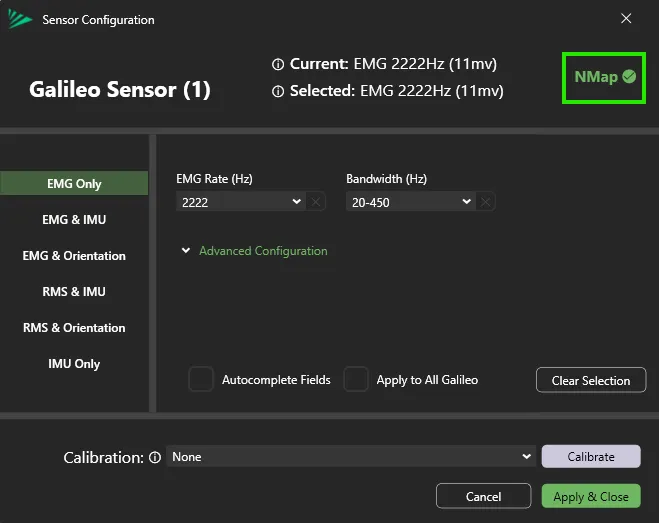
Trigno Discover NeuroMap compatible indicator
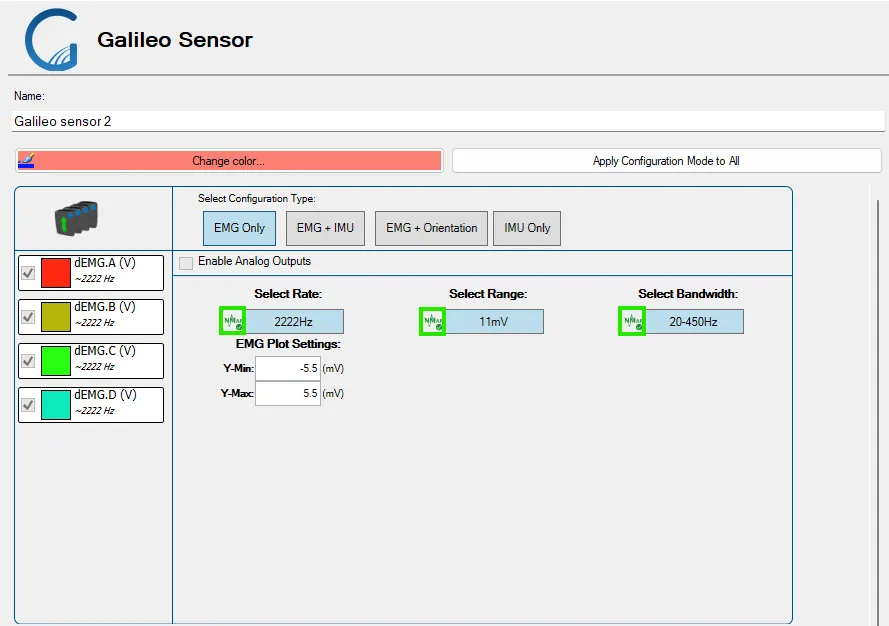
EMGworks NeuroMap compatible indicator
If the sensor configuration is not compatible with NeuroMap, a warning will appear
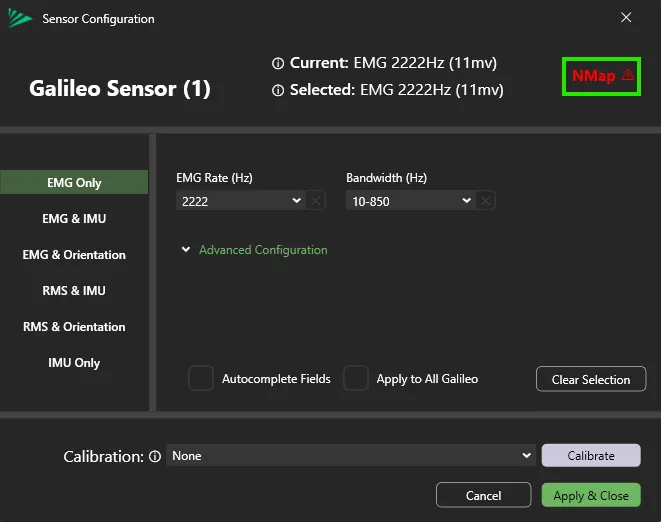
Trigno Discover NeuroMap incompatible warning
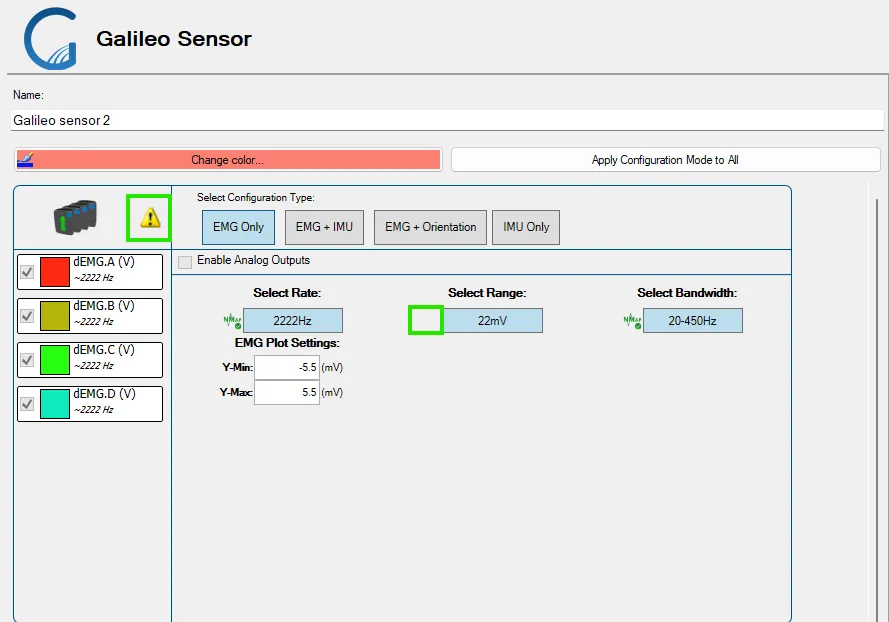
EMGworks NeuroMap incompatible warning
Important
Data must be collected in Trigno Discover or EMGworks in order to be compatible with NeuroMap for motor unit decomposition.
Step 2: Advanced Skin Preparation and Sensor Placement
Important
High-quality EMG signal is crucial for accurate motor unit decomposition. Thorough skin preparation and sensor placement are strongly recommended and will directly influence the motor unit yield.
Skin Preparation
Full skin preparation must be done at the EMG sensor head site and at the reference site. This would typically include:
Shaving the location to remove any excess hair
Light abrasion of the skin at the chosen location
Clean the location with a 70% isopropyl wipe
Sensor Placement
Place the EMG sensor head on the belly of the muscle.
Place the reference on a nearby location. Ensure that the four reference contacts are well-adhered and that the sensor lead has some slack. The reference does not have to be placed on a bony landmark.
Allow sensors to fully adhere to the skin before beginning data collection.
Once the skin has been prepared and the sensor has been placed, check the signal quality to ensure baseline noise is low.
Recommendation
A low baseline noise level (< 0.03 mV) is recommended to achieve high-quality decomposition results.
Step 3: Trial Length and Format
Trial length is recommended to be between 30 seconds to 5 minutes. This is to give the algorithm enough data to get an accurate and reliable yield, but not too much data as that will cause elongated decomposition processing time.
Motor unit decomposition takes approximately 1 minute per second of data for each sensor (i.e. a 30-second trial may take ~30 minutes to decompose from a single sensor). A trial length of 5 minutes is our recommended maximum duration to avoid elongated processing times.
Data must be exported in .HPF format. NeuroMap can only decompose raw, unedited .hpf files.
Information
Motor unit decomposition takes approximately one minute per second of data for each sensor (i.e. a 30-second trial with 2 sensors would take ~1 hour to decompose)
Summary Checklist
Before collecting data for decomposition using the Trigno system, ensure:
You are using Trigno Galileo sensors
EMG sampling frequency is 2000 Hz or 2222 Hz
EMG range is 11 mV with 20–450 Hz bandwidth
Data is collected in EMGworks or Trigno Discover
Skin prep (shave, abrade, and clean) is done at the EMG and reference sites
Your signal has a low baseline noise level (< 0.03 mV)
Trial length is between 30 seconds and 5 minutes long
Data files are exported in .HPF format
By following these guidelines, the data will be suitable for decomposition in NeuroMap and the output motor unit data and accuracy will be maximized for accuracy.
For further guidance on using NeuroMap (See Installing Neuromap and Decomposing Data)
For further guidance on interpreting decomposition results (See Analyzing Decomposed Data)
DOC-664-1-0